Is your tap water safe? It’s a question most Canadians haven’t asked since childhood, but 2026 is a reasonable time to revisit it. A growing body of evidence shows that municipal treatment – chlorination, sedimentation, basic filtration – does not catch every contaminant that ends up in your glass. PFAS (per- and polyfluoroalkyl substances), lead from aging pipes, and agricultural runoff are showing up in water systems that technically pass regulatory standards.
This guide breaks down what’s actually in Canadian tap water, how to check your local water quality, and what kind of filter removes the contaminants that matter most.
Canadian Tap Water: What Tests Actually Show
Health Canada and provincial utilities publish annual water quality reports – called Consumer Confidence Reports or Water Quality Reports depending on your province. Most households never read them. Here’s what those reports actually track and what they don’t:
What municipal treatment removes:
– Sediment, turbidity, visible particles
– Most bacteria and pathogens (via chlorination)
– Some heavy metals (varies by treatment plant)
What municipal treatment leaves behind – or adds:
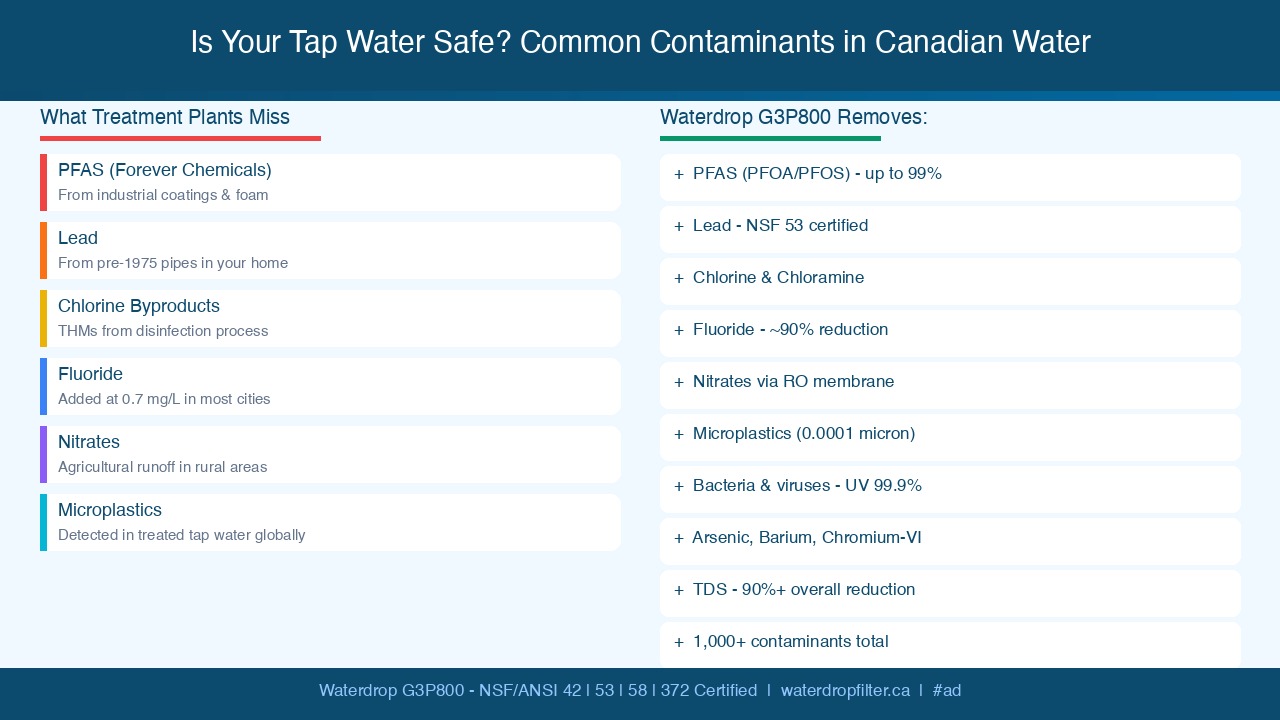
– Chlorine and chloramine: Used to disinfect, but they leave a taste and odor. Chloramine (chlorine + ammonia) is increasingly common in Canadian cities and harder to remove than chlorine alone.
– Lead: Municipal plants don’t cause lead contamination – your pipes do. Homes built before 1975 often have lead service lines or lead solder in copper plumbing. The water leaves the plant clean and picks up lead on its way to your tap.
– PFAS: Per- and polyfluoroalkyl substances are synthetic chemicals from industrial coatings, firefighting foam, and consumer products. They don’t break down in the environment and accumulate in water supplies. Health Canada’s updated PFAS advisory is among the strictest in the world, but many treatment plants weren’t designed to remove them.
– Fluoride: Added intentionally to most Canadian municipal water at 0.7 mg/L. Some people prefer to filter it out; others don’t. It’s not a safety risk at regulated levels, but it’s a choice worth knowing you can make.
– Nitrates: Common in rural areas with heavy agriculture. High nitrate levels are a health risk for infants. Rural well users in particular should test annually.
– Disinfection byproducts: When chlorine reacts with organic matter in source water, it creates trihalomethanes (THMs) and haloacetic acids (HAAs) – regulated byproducts that are reduced but not eliminated by treatment.
– Microplastics: A recent concern. Studies have detected microplastic particles in treated tap water globally. Current Canadian guidelines don’t set limits; the long-term health effects are being studied.
How to check your water:
- Search “[your city or municipality] annual water quality report 2025” – most are published online.
- The report lists contaminant levels tested at the treatment plant, not at your tap.
- For lead specifically, you need to test at your tap – contact your municipality or purchase a certified home test kit.
- For PFAS, a certified lab test costs $100-$200 and gives you specific readings. Testing is worthwhile if you’re near a military base, airport, or industrial facility.
The Under-Sink Upgrade: Waterdrop G3P800
If your water tests show any of the above concerns – or if you simply want verified peace of mind – an under-sink reverse osmosis system is the most effective home solution available.
The Waterdrop G3P800 is the most widely purchased under-sink RO system in Canada in 2026, and the specs show why:
What it removes:
– PFOA/PFOS: up to 99% (NSF/ANSI 53 and 58 certified)
– Lead: significant reduction (NSF 53)
– Fluoride: ~90% reduction via 0.0001-micron RO membrane
– Chlorine and chloramine: removed by activated carbon pre-filters
– Nitrates: addressed by RO membrane
– Arsenic, barium, chromium-VI: reduced
– Bacteria and viruses: 99.9% eliminated by UV sterilization stage
– Microplastics: blocked by 0.0001-micron membrane
– TDS: 90%+ overall reduction
– 1,000+ total contaminants addressed across 10 filtration stages
What “10-stage filtration” means:
The G3P800 runs water through multiple media types in sequence:
1. Sediment pre-filter – removes large particles, rust, sand
2-3. Carbon block pre-filters – reduce chlorine, chloramine, VOCs, THMs
4. RO membrane (0.0001 micron) – removes dissolved solids, PFAS, lead, fluoride, nitrates
5-7. Post-carbon polishing stages – refine taste and remove residual odors
8-10. UV sterilization + final polish – eliminates biological contaminants
The RO membrane at 0.0001 microns is roughly 100,000 times smaller than a human hair. It is the barrier that stops PFAS, dissolved heavy metals, and nitrates – contaminants that carbon filters alone cannot catch.
What “NSF certified” means in practice:
NSF International is an independent body that tests actual product samples – not brand-submitted data. When the G3P800 carries NSF/ANSI 58 certification, it means an independent lab has verified that the system reduces TDS, lead, and PFAS to below regulated thresholds. This is the difference between a filter that claims to remove lead and one that has been tested to prove it.
Comparing Your Options
Not every household needs a full RO system. Here’s how to match the filter to your actual water issue:
If your only concern is chlorine taste: A pitcher filter ($30-$80) or faucet filter ($50-$150) with NSF 42 certification is sufficient. Activated carbon removes chlorine effectively and cheaply. No RO needed.
If your concern is lead: You need NSF 53 certification. Carbon block pitcher filters with NSF 53 (like the Waterdrop Chubby Pitcher) handle some lead reduction. For full protection – especially in homes with lead service lines – an NSF 58-certified RO system delivers higher removal rates.
If your concern is PFAS: Only certified RO systems and some high-end activated alumina filters remove PFAS reliably. The Waterdrop G3P800 (NSF 58) and G3P600 (NSF 58) are the right tools. Carbon pitchers do not remove PFAS.
If your concern is bacteria (from a well or rural supply): UV sterilization is the correct solution – the G3P800 includes it. Systems without UV won’t address bacterial contamination.
If your concern is nitrates: Reverse osmosis only. The RO membrane is the standard treatment for nitrate reduction. No carbon filter removes nitrates effectively.
Is Tap Water Safe Without a Filter?
For most Canadians in major cities, tap water meets all Health Canada guidelines and is technically safe. But “meets minimum standards” and “clean water” are not the same thing. The guidelines allow trace amounts of many substances because eliminating them entirely would be impractical at a treatment plant scale. PFAS guidelines, for example, are being tightened because what was once considered a safe level is now under review.
The honest answer: Canadian municipal water is among the safest in the world, and the risk from unfiltered tap water for most people is low. But if you:
- Are pregnant or have a young child
- Have a family member who is immunocompromised
- Live in an older home with potentially lead-bearing pipes
- Live near a known PFAS source
- Simply want the cleanest water possible for cooking and drinking
…then a certified under-sink RO system is a rational, well-priced upgrade in 2026.
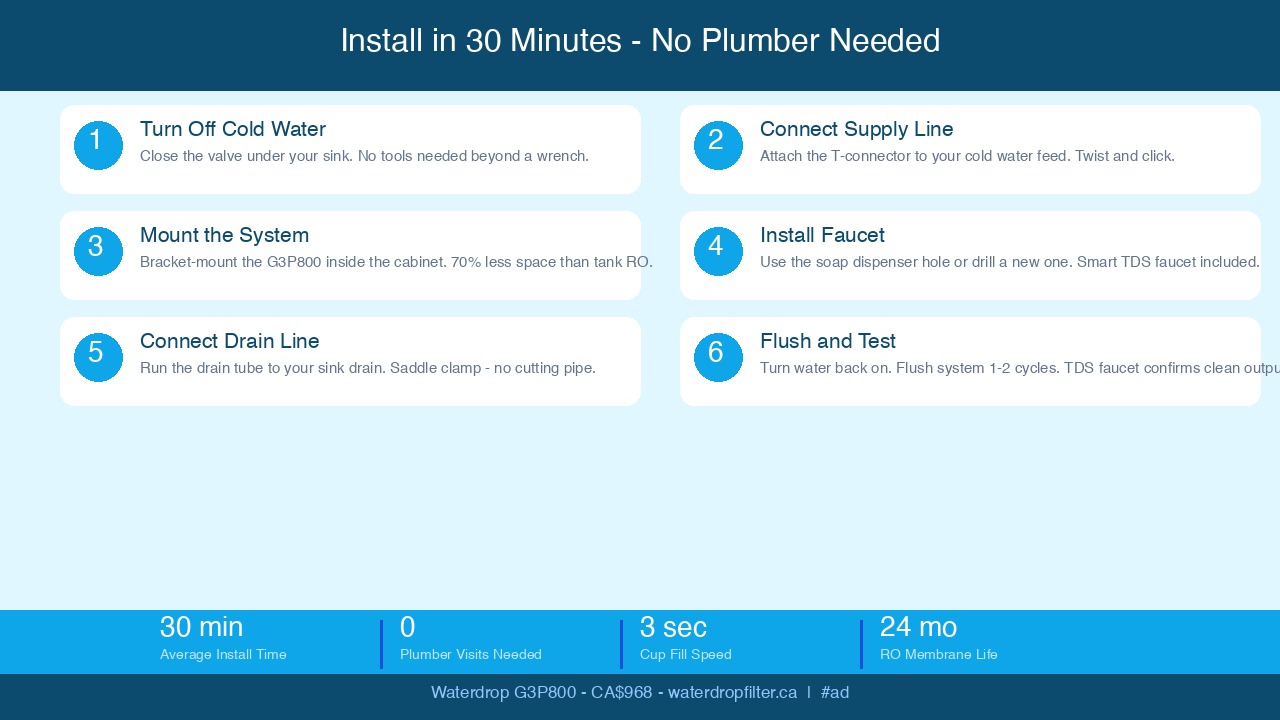
The Waterdrop G3P800 installs in 30 minutes, requires no ongoing plumber visits, and delivers verified filtration performance at a fraction of what a whole-home filtration system costs. At $968 CAD, the 5-year per-litre cost works out to less than any bottled water alternative.
If you want to compare all filter categories before deciding, our best water filters 2026 guide covers pitchers, countertop units, and under-sink RO systems side by side. For a detailed performance breakdown of each Waterdrop model, read our Waterdrop review 2026.
FAQ: Is Your Tap Water Safe in 2026?
Is Canadian tap water safe to drink in 2026?
For most Canadians in major cities, yes – tap water meets Health Canada guidelines. But guidelines allow trace amounts of contaminants including PFAS and disinfection byproducts. For households with specific concerns (older pipes, nearby industrial activity), additional filtration adds meaningful protection.
How do I find my city’s water quality report?
Search “[your city] water quality report 2025” or visit your municipality’s public works website. Most Canadian cities publish annual reports showing test results for dozens of contaminants.
What is PFAS and is it in my tap water?
PFAS are synthetic chemicals used in products like non-stick pans, stain-resistant fabrics, and firefighting foam. They’re persistent in the environment and have been detected in water systems across Canada. Health Canada has set strict new advisory levels. The only reliable way to reduce PFAS from tap water is reverse osmosis filtration with NSF 58 or 53 certification.
Is your tap water safe if you have well water?
Well water is not treated by municipalities and can contain bacteria, nitrates, arsenic, and radon depending on your geology and land use. Annual testing by a certified lab is strongly recommended. Well owners should also test after heavy rainfall or flooding.
Does boiling water remove PFAS or lead?
No. Boiling kills biological contaminants (bacteria, viruses) but does not remove lead, PFAS, nitrates, fluoride, or other dissolved chemicals. In fact, boiling concentrates dissolved solids as water evaporates. For chemical contamination, only filtration works.
Is tap water safe for babies and infants?
Health Canada recommends using fluoridated tap water to mix infant formula in most cases, but notes that households with lead pipes should filter the water first. For any contamination concern, an NSF 53 or NSF 58-certified filter is appropriate for households with infants.
How often should I replace water filter cartridges to keep water safe?
Replace on schedule, not just when you notice a taste change. Overloaded filters can release trapped contaminants back into your water. Under-sink RO systems like the Waterdrop G3P800 have filter life indicators and smart faucet alerts; pitcher filters typically need replacement every 1-3 months.