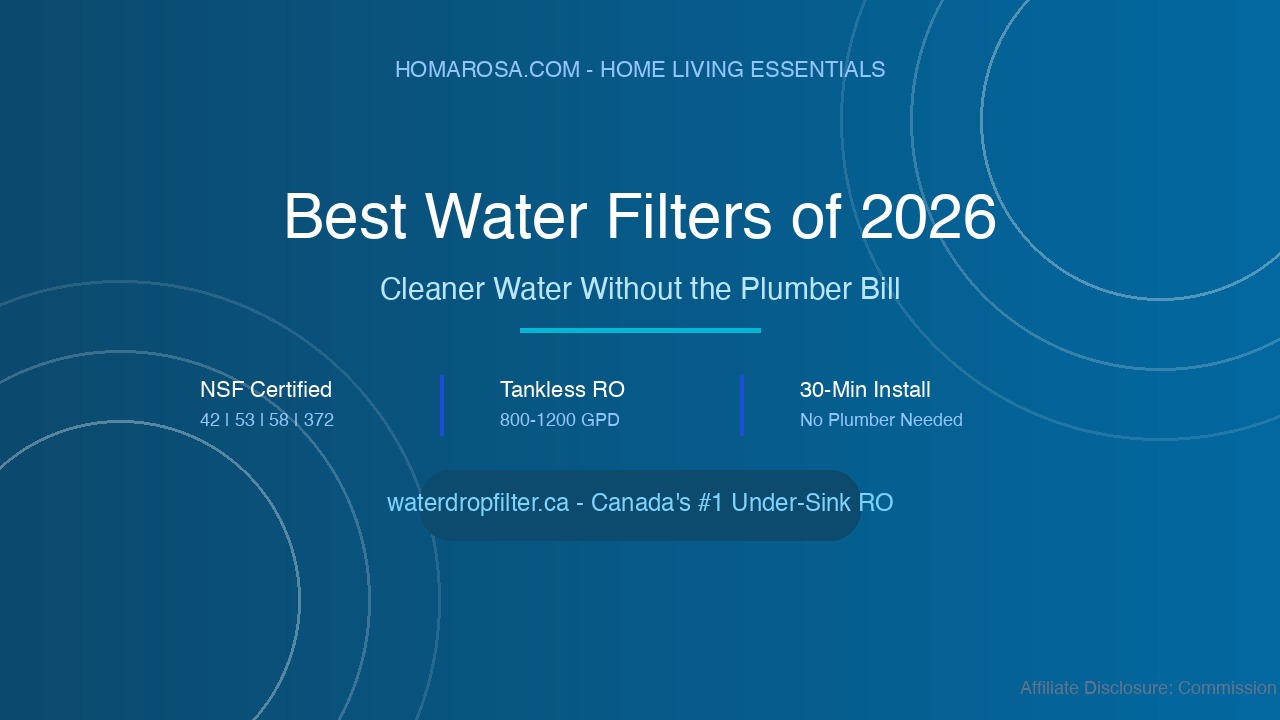
If you’re searching for the best water filters 2026 has to offer, you’re not alone. Millions of Canadian households are quietly dealing with tap water that contains chlorine aftertaste, trace lead from old pipes, and emerging contaminants like PFAS that municipal treatment doesn’t fully remove. The good news: the right home water filter solves this without a plumber visit or an expensive renovation.
This guide covers every major filter category, what each one actually removes, and the top picks at every price point – including the under-sink RO system that Canadian households are buying the most in 2026.
Water Filter Types in 2026: What Each One Actually Removes
Not all water filters do the same job. Before spending money, it helps to understand the three main categories on the market right now.
Pitcher Filters (CA$30-$80) are the entry point. They use activated carbon to reduce chlorine taste, odor, and some heavy metals. Installation: none. Limitation: they don’t remove fluoride, nitrates, PFAS, or dissolved solids – and they’re slow, filtering 1-2 cups at a time.
Countertop and Faucet Filters (CA$50-$350) sit on your counter or attach to the tap. Better carbon media handles more contaminants. Models like the Waterdrop ED01 electric pitcher upgrade the pitcher concept with faster flow and longer filter life, while countertop RO units like the Waterdrop C1SL ($309) bring full reverse osmosis to any kitchen surface without under-sink plumbing.
Under-Sink Reverse Osmosis Systems (CA$500-$2,000+) are the heavy hitters. RO membrane technology removes up to 99% of TDS (total dissolved solids), PFAS, fluoride, lead, arsenic, nitrates, and over 1,000 other contaminants – delivering clean water directly to a dedicated faucet. Tankless models like those from Waterdrop take up 70% less space than traditional tank-based RO systems and install in about 30 minutes.
| Filter Type | Price Range (CAD) | Contaminants Removed | Best For |
|---|---|---|---|
| Pitcher | $30-$80 | Chlorine, odor, some metals | Renters, light use |
| Countertop | $50-$350 | Chlorine, VOCs, some metals | Small kitchens |
| Under-sink RO | $500-$2,000+ | 1,000+ incl. PFAS, fluoride, lead | Whole-household |
The verdict for most Canadian homes in 2026: under-sink RO wins on water quality. The price has dropped dramatically, installation is DIY-friendly, and the per-glass cost is lower than bottled water.
What to Look for in Any Water Filter
1. NSF Certification
This is non-negotiable. NSF/ANSI 42 covers aesthetic contaminants (chlorine, odor). NSF/ANSI 58 covers RO systems reducing TDS, lead, arsenic. NSF/ANSI 53 covers health-effect contaminants including PFAS. A filter claiming to remove lead or PFAS without NSF certification is just a marketing claim.
2. Contaminant List vs. Your Water
Start with your municipality’s annual water quality report (search “[your city] drinking water report”). If your home has pre-1970 plumbing, add lead to your list. Rural homes should test for nitrates and bacteria. Urban homes across Canada should consider PFAS filtration – Health Canada’s advisory limit for PFAS is among the strictest globally, and municipal plants weren’t built to handle it.
3. Flow Rate (GPD for RO)
Gallons per day (GPD) matters for under-sink RO. An 800 GPD system fills a cup in seconds. Older 50-100 GPD systems take minutes and rely on a large storage tank. Modern tankless systems at 600-1200 GPD have eliminated the tank entirely.
4. Filter Life and Replacement Cost
The purchase price is only part of the equation. Check how often filters need replacing and what they cost. A system with $200/year in filters costs more over 5 years than one with $80/year in filters, even if the upfront price is the same.
5. Installation Complexity
Most under-sink filters connect to the cold water supply line under the sink and require no special tools beyond a wrench. Modern twist-and-pull filter cartridges mean you don’t need a plumber for maintenance either. Tankless systems are easier to install than tank-based ones because there’s no pressurized tank to manage.
Best Under-Sink RO: Waterdrop G3P800
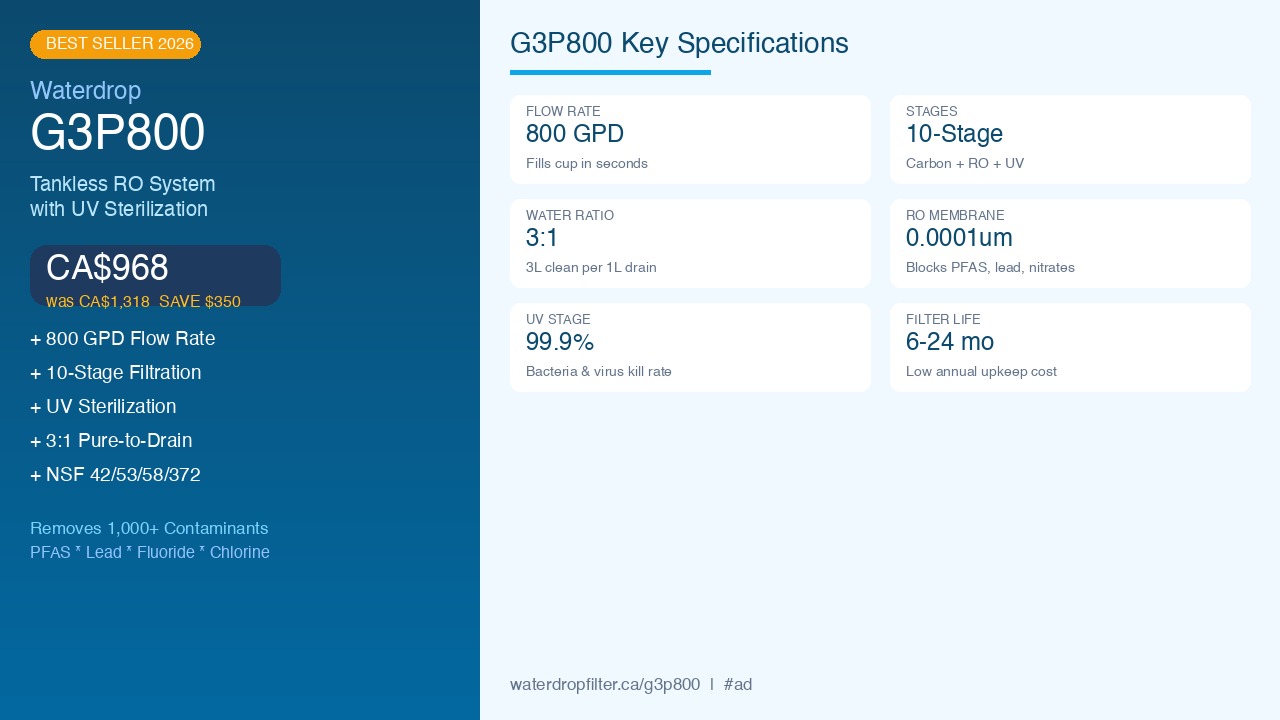
The Waterdrop G3P800 is the benchmark for under-sink RO in Canada in 2026. Here’s what makes it worth the $968 CAD price tag (down from $1,318 during promotions):
The specs that matter:
– 800 GPD flow rate – fills an 8oz glass in seconds
– 10-stage filtration including activated carbon, RO membrane (0.0001 micron), and UV sterilization
– NSF/ANSI 42, 53, 58, and 372 certified
– Removes PFOA/PFOS up to 99%, fluoride, lead, chlorine, arsenic, chromium, and 1,000+ other contaminants
– 3:1 pure-to-waste water ratio – dramatically better than older 1:3 or 1:4 systems
– Tankless design: 70% less under-sink space than traditional systems
– Smart digital faucet displays real-time TDS levels
– 30-minute DIY installation; no plumber required
– Filter life: 6 months (CF), 12 months (CB), 24 months (RO membrane)
– 1-year warranty, 30-day returns
The UV sterilization stage is the detail that separates the G3P800 from most competitors: it eliminates 99.9% of bacteria and viruses that could grow in the system or piping after filtration – something carbon and RO alone can’t address.
Best for: Families who want the highest contaminant removal, especially PFAS and fluoride, with minimal maintenance and no tank to worry about.
Shop Waterdrop G3P800 at waterdropfilter.ca
The Rest of the Best Water Filters 2026 Lineup
Waterdrop X12 – Best Performance Upgrade (CA$1,299)
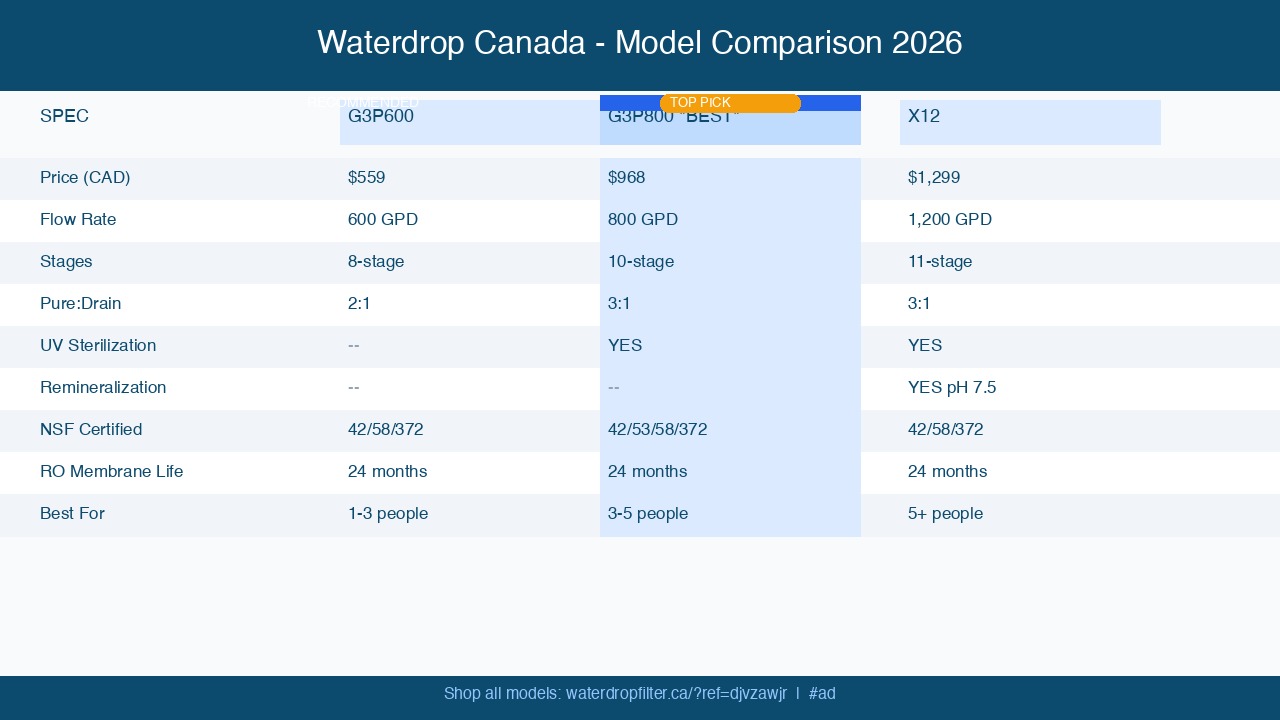
The X12 steps up to 1200 GPD and 11-stage filtration, adding alkaline remineralization that brings filtered water to a pH of 7.5 – slightly alkaline, which many people prefer for taste. It also includes UV sterilization and a smart TDS faucet. At $1,299 (down from $1,699), it’s the right call for larger households or anyone who wants alkaline remineralization built in rather than added separately.
Key specs: 1200 GPD, 11-stage, alkaline pH 7.5+, UV, NSF 42/58/372, fills a 6oz cup in 3 seconds.
Waterdrop G3P600 – Best Value Under-Sink RO (CA$559)
The G3P600 at $559 delivers 600 GPD through 8-stage filtration with NSF/ANSI 42, 58, and 372 certification. It removes the same core contaminants – PFAS, fluoride, lead, chlorine, arsenic – with a slightly lower flow rate and 2:1 water ratio vs. the G3P800’s 3:1. For a household of 1-3 people, this is the smartest buy.
Key specs: 600 GPD, 8-stage, 2:1 ratio, tankless, smart TDS faucet, 30-min install.
Waterdrop Chubby Pitcher – Best No-Install Option (CA$47.99)
For renters or anyone who can’t install under-sink equipment, the Waterdrop PT-04 Chubby Pitcher at $47.99 uses a premium carbon block to reduce chlorine, taste, and odor. No installation, no electricity, no plumbing. It won’t touch PFAS or fluoride, but it’s the right starting point before upgrading.
How Much Does a Water Filter Actually Cost Per Year?
Here’s a realistic 5-year cost breakdown for the top options:
| System | Upfront (CAD) | Annual Filters (est.) | 5-Year Total |
|---|---|---|---|
| Pitcher (PT-04) | $47.99 | ~$46 | ~$278 |
| G3P600 | $559 | ~$115 | ~$1,134 |
| G3P800 | $968 | ~$145 | ~$1,693 |
| X12 | $1,299 | ~$165 | ~$2,124 |
Bottled water for a family of 4 costs roughly $700-$1,200/year. An under-sink RO system pays for itself in 2-3 years versus bottled water – and delivers cleaner water than most bottled brands, which aren’t required to remove PFAS.
For a full breakdown of how each Waterdrop system performs head-to-head, read our Waterdrop review for 2026. If you’re unsure whether you need a filter at all, start with our guide on whether your tap water is actually safe in 2026.
FAQ: Best Water Filters 2026
What is the best water filter for a Canadian home in 2026?
For most households, an under-sink RO system with NSF 58 certification is the best choice. The Waterdrop G3P600 ($559) handles 1-3 person households well; the G3P800 ($968) is the best all-rounder for families. Both remove PFAS, fluoride, lead, and over 1,000 other contaminants.
Do I need a water filter if my tap water meets Health Canada guidelines?
Meeting minimum guidelines doesn’t mean your water is contaminant-free. Guidelines allow trace amounts of many substances, and PFAS limits are still being updated. A certified RO system adds a second layer of protection beyond municipal treatment.
How often do I need to replace water filter cartridges?
It depends on the system. Under-sink RO systems like the Waterdrop G3P800 have pre-filters lasting 6-12 months and an RO membrane lasting 24 months. Pitchers need filter replacements every 1-3 months depending on usage.
Can I install an under-sink water filter myself?
Yes. Tankless systems like Waterdrop connect to the cold water supply under your sink – no special plumbing skills needed. Installation takes about 30 minutes with a wrench. Detailed instructions and video guides come with every system.
Is reverse osmosis water safe to drink long-term?
Yes. RO water is clean, not “empty” – it tastes better because the dissolved solids that cause mineral or chemical flavors are removed. If you prefer minerals in your water, choose an RO system with remineralization (like the Waterdrop X12) that adds beneficial calcium and magnesium back after filtration.
What’s the difference between NSF 42 and NSF 58?
NSF 42 certifies that a filter reduces aesthetic contaminants like chlorine taste and odor. NSF 58 certifies that an RO system reduces health-effect contaminants including TDS, lead, arsenic, and PFAS. Any serious under-sink filter should carry both.
Does Waterdrop ship to all of Canada?
Yes. Waterdrop ships across Canada from their Canadian site, waterdropfilter.ca. Orders placed during promotions include 30-day price protection.