This Waterdrop review covers the brand’s three most popular under-sink RO systems available in Canada in 2026: the G3P600, G3P800, and X12. If you’ve seen Waterdrop ads online or in your local home improvement store and wondered whether the performance matches the marketing, this breakdown has the real specs, the real limitations, and a clear recommendation based on household size and budget.
Waterdrop is a US-founded brand that has become one of the dominant forces in under-sink water filtration globally, with a Canadian storefront at waterdropfilter.ca. Their tankless RO systems replaced the bulky pressurized-tank design that dominated the market for decades – and for most households, the upgrade is genuinely worth it.
Waterdrop Review: What the Brand Sells in Canada
Waterdrop Canada (waterdropfilter.ca) organizes its lineup into four main categories:
Under-Sink RO Systems (their core product): The X and G series. These are tankless, wall-mounted under the sink, and connect directly to your cold water line. No dedicated storage tank means no stale water and 70% less cabinet space used.
Countertop RO Systems: The A, C, and CoreRO series for households that can’t modify plumbing. The C1SL Alkaline ($309) brings remineralization to a countertop footprint.
Electric Pitchers: The ED01 and ED01A use carbon + RO-style filtration in a pitcher format. Not full RO, but a serious upgrade from basic pitcher filters.
Standard Pitchers: The PT-04 Chubby Pitcher ($47.99) for entry-level filtration with no installation.
The under-sink systems are where Waterdrop dominates. Their G and X series hold NSF/ANSI 42, 58, and 372 certifications (the G3P800 adds NSF/ANSI 53), making them among the most certified consumer water filters available in Canada.
Waterdrop G3P600 vs G3P800 vs X12: Which to Buy?
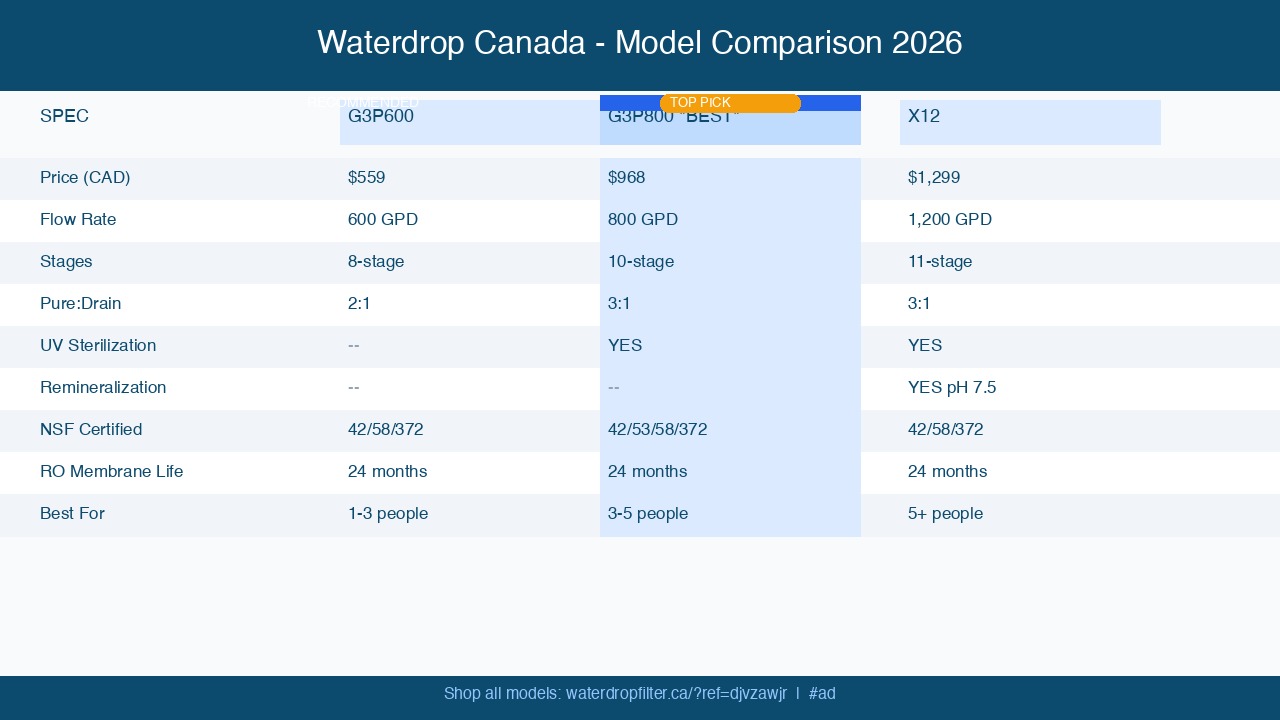
Here is the head-to-head comparison that most buyers need before choosing:
| Spec | G3P600 | G3P800 | X12 |
|---|---|---|---|
| Price (CAD) | $559 (was $699) | $968 (was $1,318) | $1,299 (was $1,699) |
| Flow Rate | 600 GPD | 800 GPD | 1,200 GPD |
| Filtration Stages | 8-stage | 10-stage | 11-stage |
| Pure-to-Drain Ratio | 2:1 | 3:1 | 3:1 |
| UV Sterilization | No | Yes | Yes |
| Alkaline Remineralization | No | No | Yes (pH 7.5+) |
| NSF Certifications | 42, 58, 372 | 42, 53, 58, 372 | 42, 58, 372 |
| RO Membrane Life | 24 months | 24 months | 24 months |
| Smart TDS Faucet | Yes | Yes | Yes |
| Tankless Design | Yes | Yes | Yes |
The differences translate directly into use cases:
G3P600 ($559): Best for 1-3 person households. 600 GPD is still many times faster than an old tank-based system. No UV means you’re relying on the carbon and RO stages alone – excellent for contaminant removal, but the G3P800’s UV stage adds biological protection. The 2:1 ratio is slightly less water-efficient but still far better than older systems.
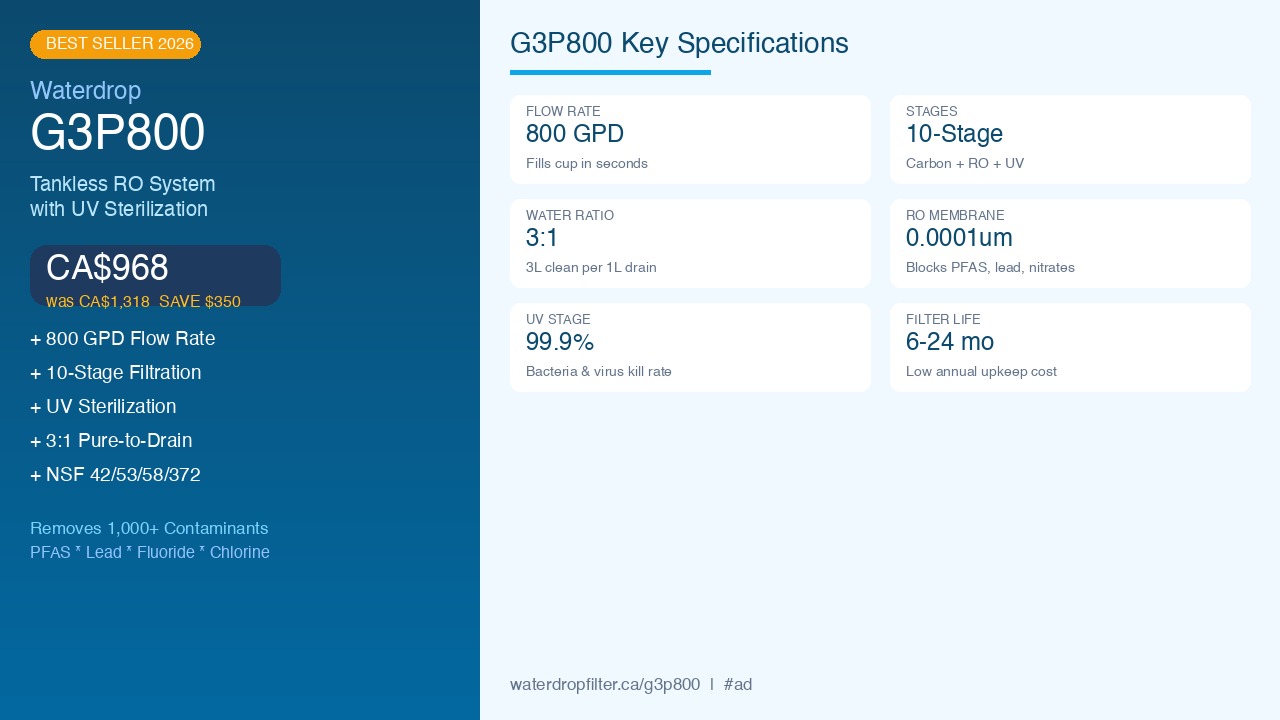
G3P800 ($968): The sweet spot. Adds UV sterilization, improves the pure-to-drain ratio to 3:1, and bumps to 10-stage filtration with NSF 53 certification for health-effect contaminants including PFAS. For a family of 3-5, this is the right pick – and during Waterdrop’s Day Sale events, the price drops to around $968 from $1,318.
X12 ($1,299): For larger households or anyone who wants built-in alkaline remineralization. The 11th stage adds calcium and magnesium back to the filtered water, raising pH to 7.5+. At 1,200 GPD, it delivers a 6oz cup in about 3 seconds. The step up from G3P800 is worth it primarily for remineralization and raw throughput.
Waterdrop G3P800: Detailed Performance Breakdown
Since the G3P800 is Waterdrop’s bestselling Canadian model, it deserves closer attention.
Contaminant removal: The G3P800 targets over 1,000 contaminants. The certified reductions that matter most for Canadian tap water:
– PFOA/PFOS: up to 99% (NSF 58 certified)
– Fluoride: significant reduction via RO membrane
– Lead: substantial reduction (NSF 53 certified)
– Chlorine and chloramine: reduced by pre-carbon stages
– Arsenic, barium, chromium-VI: addressed by RO membrane
– Bacteria and viruses: 99.9% eliminated by UV stage
– TDS: reduces by 90%+ depending on source water
Installation: Waterdrop’s 30-minute installation claim is realistic. The G3P800 connects to the cold water supply valve under the sink, runs a drain line to the sink drain, and has a dedicated faucet that replaces or supplements your sink’s soap dispenser hole. No permanent modifications. No plumber needed unless your under-sink plumbing is unusually complex.
Filter maintenance: Three filter cartridges use a twist-and-pull replacement system – no tools, no water shutoff during the swap. The N1CF pre-filter ($49.99) replaces every 6 months. The N3CB carbon block ($44.99) replaces every 12 months. The G3P800-RO membrane ($119.99) replaces every 24 months. Annual filter cost: approximately $145 CAD.
Smart faucet: The dedicated faucet displays real-time TDS (total dissolved solids) levels in your filtered water. Normal filtered output for most Canadian tap water runs 5-15 TDS versus 100-300+ TDS from the tap. The display also alerts you when filters need changing.
Water waste: At a 3:1 ratio, the G3P800 sends 1 litre of drain water for every 3 litres produced. Older RO systems ran 3-4 litres of drain water per litre produced. Still not zero-waste, but a meaningful improvement.
What Waterdrop Gets Right
Tankless design is a genuine upgrade. Pressurized storage tanks – the standard for decades – create a surface area for bacterial growth and often cause a stale water taste over time. Tankless systems produce water on demand. There’s no stored water to go stale.
NSF certifications are real. Some water filter brands cite lab tests rather than third-party NSF certification. Waterdrop’s certifications (NSF/ANSI 42, 53, 58, 372) are independently verified. This matters when you’re relying on a filter for health protection against PFAS or lead.
Warranty and returns. 1-year warranty, 30-day money-back returns. For a $968+ appliance, this is reasonable – not exceptional, but fair.
Waterdrop’s Limitations
Price. Even on sale, the G3P800 at $968 CAD is not cheap. If your primary goal is just chlorine taste reduction, a $47.99 pitcher does that. The full RO lineup makes sense for households with real water quality concerns – PFAS, lead, fluoride – not just aesthetic preferences.
Electricity required. The UV sterilization stage and smart faucet display on the G3P800 and X12 require a power outlet under the sink. Most modern kitchens have one, but older homes may need an outlet added.
Water waste. Even at 3:1, RO systems waste water. This matters more in areas with water restrictions. If sustainability is the top priority, a high-quality carbon block filter wastes nothing – but also doesn’t touch PFAS or fluoride.
Who Should Buy Waterdrop in Canada
Waterdrop makes the most sense if:
- Your tap water has a chlorine taste, mineral smell, or visible particles
- You live in a home with pre-1970 plumbing (potential lead pipes)
- Your municipal water report shows PFAS, nitrates, or elevated hardness
- You’re currently spending $30-$80/month on bottled water
- You want lab-certified contaminant removal, not just marketing claims
It makes less sense if you’re renting and can’t install under-sink equipment, or if you have a well with specific bacterial concerns that require more than UV coverage (consult a water treatment specialist in those cases).
Our complete breakdown of the best water filters 2026 covers every filter category at every price point if you’re still comparing options.
FAQ: Waterdrop Review Questions
Is Waterdrop a legitimate brand?
Yes. Waterdrop is NSF-certified across its product line, ships from a Canadian warehouse at waterdropfilter.ca, and has been operating in North America since 2015. Their products are not a grey-market import – they hold Canadian warranty and return coverage.
How does Waterdrop compare to Brita or PUR?
Brita and PUR pitcher filters use activated carbon to reduce chlorine, taste, and some metals. They do not use reverse osmosis, so they cannot remove PFAS, fluoride, nitrates, or dissolved solids. Waterdrop’s RO systems remove contaminants that pitcher filters cannot address. The comparison is more like a car filter vs. a hospital-grade air purifier.
Does the Waterdrop G3P800 remove PFAS?
Yes. The G3P800 is NSF/ANSI 53 and 58 certified, and NSF 58 covers PFOA/PFOS reduction. The G3P800 reduces PFAS by up to 99%. This is one of its strongest selling points for Canadian households where PFAS has been detected in municipal water systems.
How long does the Waterdrop G3P800 installation take?
About 30 minutes for most standard kitchen setups. You need access to the cold water supply valve under your sink and the sink drain. The system comes with all necessary tubing, fittings, and a dedicated faucet. Detailed video instructions are included.
What is Waterdrop’s warranty in Canada?
All Waterdrop systems purchased through waterdropfilter.ca come with a 1-year warranty and 30-day money-back guarantee. Filter replacements are available directly through the Canadian site.
Does Waterdrop remove fluoride?
Yes. The RO membrane in all G and X series systems reduces fluoride. The exact reduction percentage depends on incoming water fluoride levels, but RO membranes typically remove 85-95% of fluoride.
Is the smart TDS faucet necessary?
It’s included in all G and X series systems. The TDS display is useful for confirming the filter is working properly and for timing replacements – but it’s not essential to the filtration function. The faucet can operate without the display feature active.
For more on whether your specific tap water needs filtering, see our guide on whether your tap water is safe in 2026.