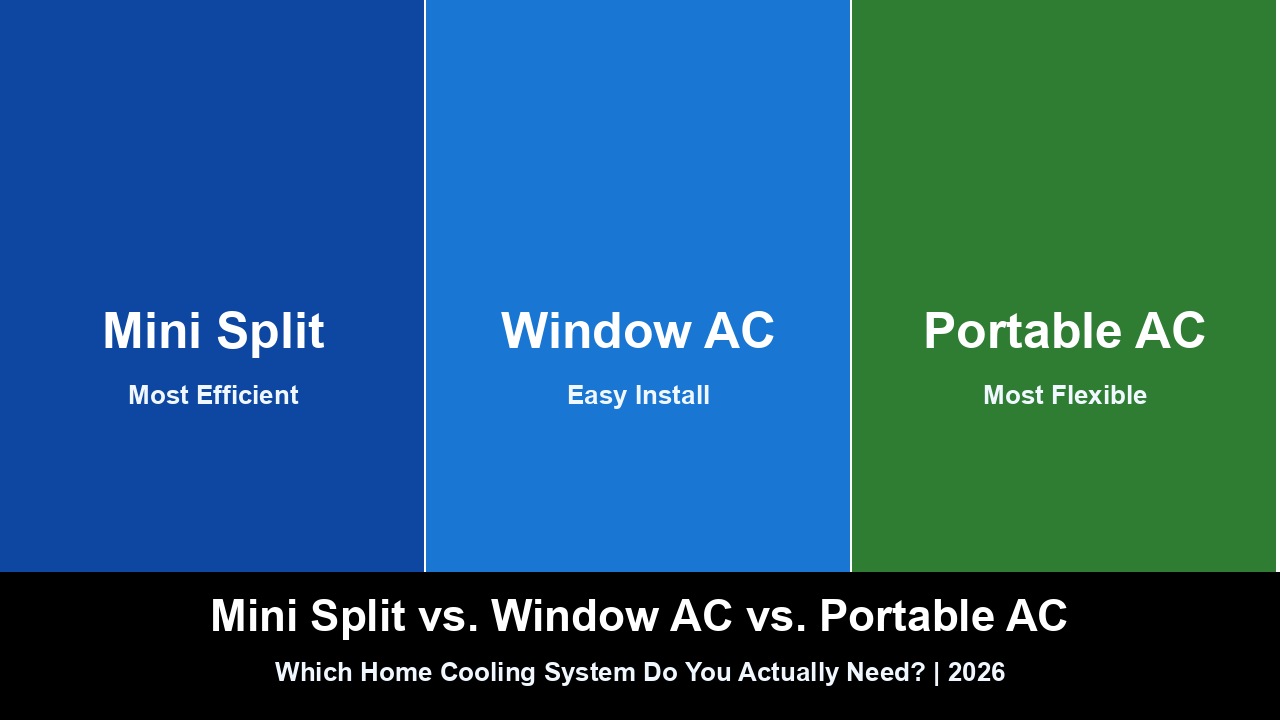
The mini split vs. window AC question has gotten more layered as both categories have evolved in 2026 – and portable ACs have improved enough to be a genuine third option for the right situation. The honest answer is that no single system wins for everyone. The right choice depends on how permanent the installation needs to be, how much space needs cooling, what your ownership situation allows, and how you weigh upfront cost against long-term operating expenses.
This comparison gives you real numbers, real use cases, and a clear decision framework so you leave knowing which system fits your specific situation – not just a generic recommendation.
What You Are Actually Comparing
Before the numbers, understand what each system does differently.
Mini split (ductless AC): A permanently installed system with an outdoor compressor and one or more indoor air handlers connected by refrigerant lines through the wall. No window access required. Cools and heats. Needs professional installation. Highest upfront cost, lowest long-term operating cost.
Window AC: A self-contained unit installed in an open window. No professional installation required. Cools only in most models. Blocks one window. Lower upfront cost, moderate operating cost.
Portable AC: A freestanding unit that sits on the floor and vents through a window hose. No permanent installation. Cools only in most models. Most flexible – can move between rooms. Lower upfront cost, highest operating cost.
Mini Split vs Window AC: The Full Comparison
Upfront Cost
Using Dellahome’s current pricing as a real-world reference:
| System | Dellahome Model | Price |
|---|---|---|
| Window AC (6,000 BTU) | Fenestra Series Smart | $229.96 |
| Portable AC (12,000 BTU) | Smart Portable | $459.00 |
| Portable AC (14,000 BTU) | Inverter Ultra Quiet | $539.96 |
| Mini Split (12,000 BTU) | Serena Series | $779.96 |
| Mini Split (18,000 BTU) | Serena Series | $1,049.96 |
| Mini Split (24,000 BTU) | Serena Series | $1,499.96 |
The mini split costs 2-3 times more upfront than a window unit of similar cooling capacity. That gap looks smaller when you account for: no window space lost, no window modification required, tax rebates (Energy Star mini splits qualify for federal and state incentives), and monthly operating cost differences over a 15-20 year system life.
Efficiency – Where Mini Splits Win Decisively
This is the category where the comparison is not close.
- Window AC: Typically 10-12 SEER2 at most price points. Meets minimum federal standards; does not qualify for Energy Star rebates.
- Portable AC: Typically 8-11 SEER2. The least efficient of the three options.
- Mini Split (Dellahome Serena): 22 SEER2. Energy Star certified. Roughly twice as efficient as a window unit for the same cooling output.
In practical terms: running a 12,000 BTU 22 SEER2 mini split for 8 hours daily costs roughly $21-$26 per month at average US electricity rates ($0.16/kWh). The equivalent window unit at 11 SEER2 runs roughly $40-$47 per month for the same cooling. That is a difference of around $200-$250 per year – every year.
Over five years, the efficiency gap more than compensates for the mini split’s higher purchase price in most use cases.
Installation
Window AC: Fits in most double-hung windows. Self-installable in under an hour. Blocks one window for the season. Requires the window frame to support the weight.
Portable AC: Zero installation. Vent hose goes through a cracked window or sliding door. Sits on the floor and takes up interior space. The hose connection is typically the weakest point in efficiency terms – warm air can leak back in around a poorly sealed kit.
Mini Split: Requires a 3-inch opening through an exterior wall, refrigerant line connection, and a dedicated electrical circuit. Needs a licensed HVAC technician in most US states (EPA 608 certification is required to handle refrigerant). Professional installation runs $500-$1,500 depending on complexity and region.
If you own your home and plan to stay, mini split installation is a one-time cost that serves the space for 15-20 years. If you rent or move frequently, window or portable units avoid the installation commitment entirely.
Noise
Window AC: Moderate noise level. The entire unit – compressor and fan – is in or near the room. Typically 50-60 dB during operation.
Portable AC: Loudest of the three. The compressor sits inside the room with you. Typically 55-65 dB – noticeably present in a quiet bedroom or home office.
Mini Split: Quietest by a significant margin. The compressor lives outside; only the indoor air handler (essentially a fan) operates inside. Typically 20-40 dB. For bedrooms, home offices, or recording spaces, this difference matters considerably.
Heating Capability
Window AC: Cools only in most models. Some higher-end units include electric resistance heat, but this is inefficient.
Portable AC: Cools only in most models. Not a practical heating solution.
Mini Split: All Dellahome mini splits are heat pumps that both cool and heat. Heat pump heating is typically 2-3 times more efficient than electric resistance. For homeowners who can use a single system for both heating and cooling, the ROI calculation changes significantly.
The Dellahome Optima Series Ultra Heat is specifically rated for performance in colder climates where temperatures regularly drop below 20°F. The standard Serena Series handles moderate climates effectively.
Mini Split vs Window AC: The Decision Framework
Choose a mini split if:
- You own your home and plan to stay 3 or more years
- The room is 300 sq ft or larger and needs both cooling and heating
- You want the lowest possible operating cost over time
- You can take advantage of federal and state energy rebates
- Noise is a concern – bedroom, home office, or quiet living space
- You want to consolidate heating and cooling into one efficient system
Choose a window AC if:
- You rent or move frequently
- Budget is the primary constraint and upfront cost matters most
- The room is smaller – under 350 sq ft – and needs cooling only
- You have a compatible double-hung window available
- You want a simple seasonal solution with no installation cost
Choose a portable AC if:
- No window is accessible for a traditional window unit installation
- The landlord prohibits window unit installations
- You need to move the cooling source between rooms during different parts of the day
- You need temporary cooling during a renovation or while waiting for a permanent system
Where Dellahome Fits Across All Three
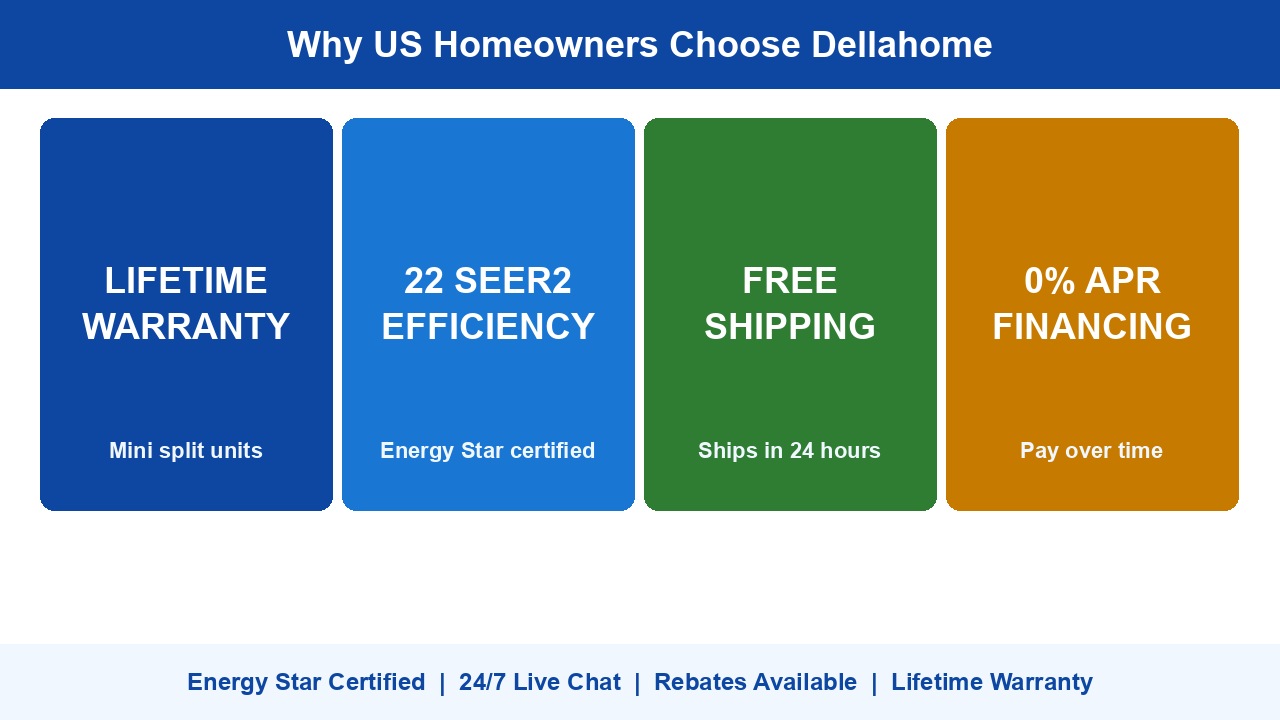
Dellahome builds all three cooling types within a single brand ecosystem, which makes it straightforward to stay with one manufacturer and one support channel regardless of which system fits your situation.
Window AC: The Fenestra Series 6,000 BTU Smart Window AC ($229.96) covers 150-250 sq ft, includes WiFi and app control, and is a capable entry-level option for smaller spaces and renters.
Portable AC: The 12,000 BTU Smart Portable ($459) handles rooms up to 350 sq ft, and the 14,000 BTU Inverter Ultra Quiet ($539.96) covers up to 450 sq ft with the quietest portable operation in Dellahome’s lineup.
Mini Split (Serena Series): The clear long-term value choice. 22 SEER2, lifetime warranty, starts at $779.96 for up to 550 sq ft. Free shipping that ships in 24 hours. 0% APR financing. All three sizes – 12,000 / 18,000 / 24,000 BTU – share the same efficiency rating and warranty terms.
For a complete look at everything the Serena Series offers, read our Dellahome Serena Series review 2026. For full BTU sizing guidance and model selection, see our best mini split AC for 2026 buyer’s guide.
See the full Dellahome cooling lineup
Mini Split vs Window AC: FAQ
Is a mini split really better than a window AC?
For permanent installation in owned homes, yes in almost every measure that matters long-term: quieter (20-40 dB vs. 50-60 dB), roughly twice as efficient (22 SEER2 vs. 10-12 SEER2), and capable of heating as well as cooling. For renters or short-term situations, window ACs make more financial sense due to lower upfront cost and zero installation.
How much does a mini split save vs. a window AC per month?
A 12,000 BTU 22 SEER2 mini split running 8 hours daily costs roughly $21-$26 per month at average US electricity rates. An equivalent 12,000 BTU window AC at 11 SEER2 runs roughly $40-$47 per month. The difference is approximately $15-$20 per month – around $200 per year – not including rebate savings.
Can a mini split replace central air entirely?
A single mini split cools one zone. Multi-zone systems (one outdoor unit connected to 2-4 indoor handlers) can cool multiple rooms from a single compressor. For whole-home cooling across many rooms, a multi-zone setup or central air is more practical. For individual rooms, additions, or homes without ductwork, mini splits are often superior.
Is a portable AC worth it?
For situations where no other option is practical – no accessible window, rental restrictions, or purely temporary use – a portable AC is a workable solution. They are the least efficient of the three options and the noisiest, but they work when installation of any kind is not possible.
Which Dellahome AC is best for a 400 sq ft room?
For a permanent installation, the Dellahome Serena 12,000 BTU Mini Split ($779.96) is the best long-term choice – it covers up to 550 sq ft at 22 SEER2 with a lifetime warranty. For a zero-installation option, the Dellahome 12,000 BTU Smart Portable AC ($459) covers up to 350 sq ft.
Do window ACs qualify for energy rebates?
Standard window AC units at 10-12 SEER2 do not typically qualify for Energy Star rebates. Mini splits at 22 SEER2 or higher qualify for federal tax credits under the Inflation Reduction Act (up to 30% of installed cost, capped at $2,000) plus state and utility rebates where available.
How long does a mini split last compared to a window AC?
Well-maintained mini splits typically last 15-20 years. Window AC units typically last 8-12 years with regular maintenance. The Dellahome Serena Series lifetime warranty means the unit itself is covered for its entire service life – something no window AC manufacturer offers.